Bouldering is incredible as an outdoor activity.
And right now, it is having its moment.
It is experiencing a rush of new rock-climbing enthusiasts due to its accessibility as a hobby.
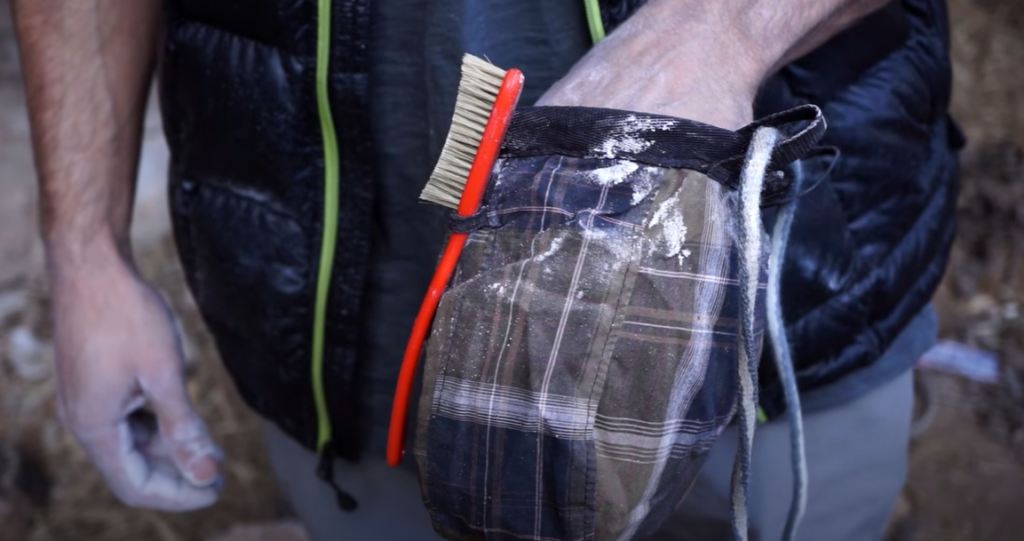
A chalk bag and a pair of climbing shoes are all you will ever need in bouldering, unlike hiking, where heavy loads are the norm. On top of that, for outdoor climbing, a pad is essential to climbing safely.
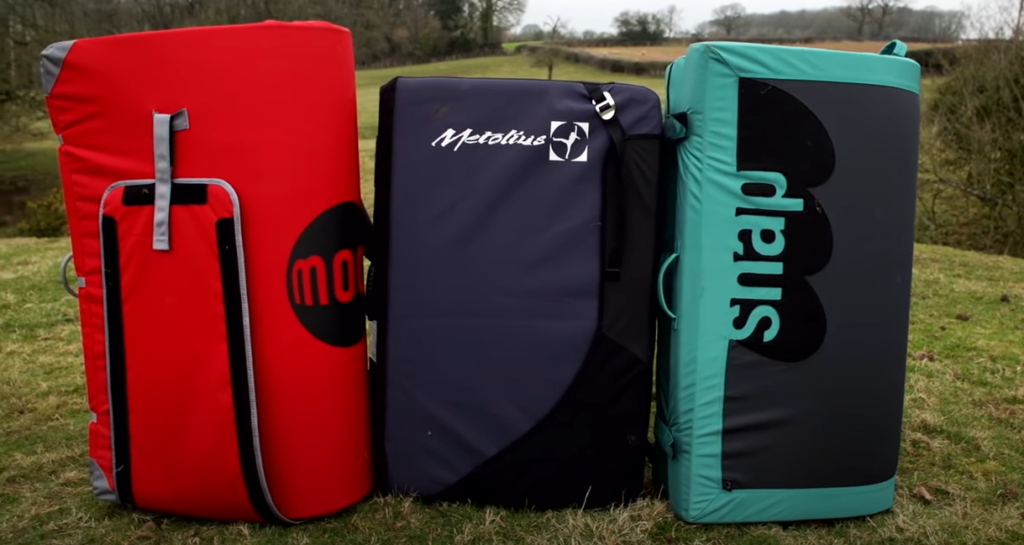
You do not want to have climbed to the top of a peak to fall, hurting yourself. Fortunately, today there are more crash pad choices than ever before, from custom pieces to modern designs from traditional companies such as Black Diamond or Metolius.
In this guide, we recommend some of the best crash pads for bouldering. From supplemental to oversized, we researched and tested each one of them.
For instance, we took them for a hike in the backcountry, spread them underneath cliffs, and placed them next to roadside highballs to verify how each performs at low and high falls.
And we also took extra care to record their durability and features. Therefore, you have all the essential information when choosing the best bouldering crash pad and ensuring your safety.
What are Bouldering Pads and Why Should You Use Them?
Imagine climbing on a cliff but falling.
And you land on sharp rocks and boulder fragments.
To avoid getting harmed, you have to land on something that can absorb the shock from the fall and stop injuries to your body and feet.
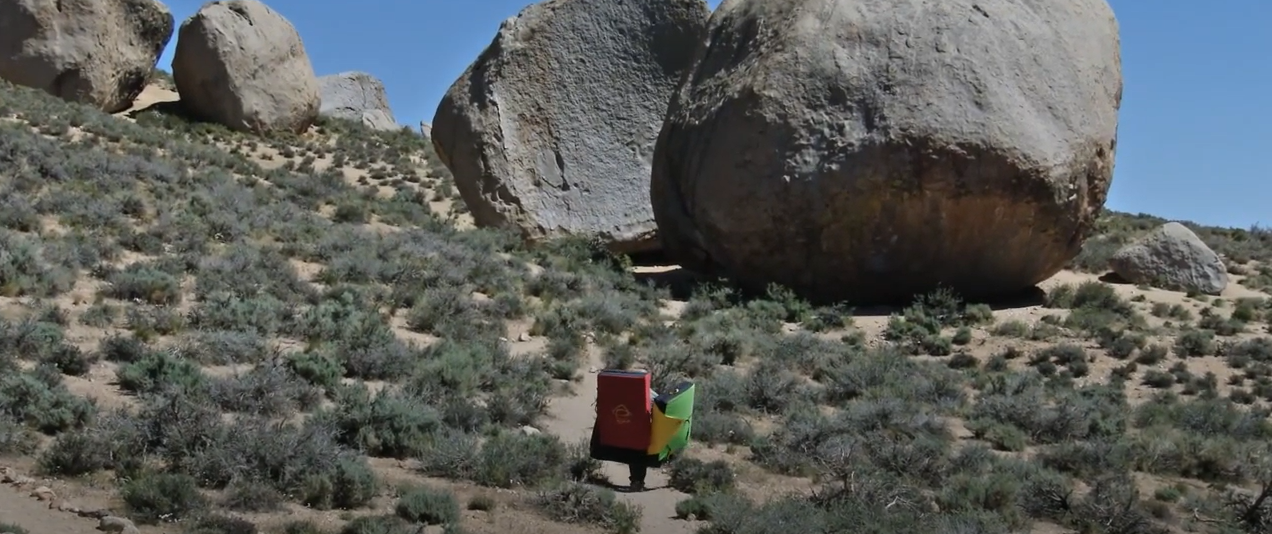
That something is a rock climbing pad, a thick foam core with a few layers of hardness, covered in protective and waterproof fabric. Besides, a rock climbing mattress has a rucksack-style set of removable shoulder straps to carry along and can fold up to a smaller size.
Also, it can secure with a locking strap and taken on the back. A pad might include Velcro areas for attaching multiple mats, pockets, and a top carrying handle. Or it may have a detachable mat for cleaning shoes or an extra fold-out for starting routes.
Different Bouldering Crash Pads Types and Sizes
A crash pad does not come in one size only. It comes in different categories because multiple factors affect the protection it provides.
Size is the most prevalent factor affecting safety, however. So, a larger pad will cover more ground and offer more security.
For light climbing, where falling, at worse, would be small, boulderers choose regular-sized designs. But when it is about falling from high heights, full or oversized ones are favored, instead.
And if boulderers feel that a pad is not enough, they may opt for a supplemental to cover even more ground, too.
Without further ado, these are the main design categories:
Regular
Regular are basic designs. Climbing enthusiasts, especially those without substantial climbing experience, will find them perfect for protecting from several injuries. On top of that, experienced boulderers may choose these mattresses for another pad to add protection.
These designs average 36 x 48 inches (3 x 4 feet) when unfolded and have the same thickness as oversized ones (4 to 5 inches). They are excellent, as they strap onto a larger pad, too. And their size is fantastic for bouldering circuits or when climbing alone without a group.
Full
For boulderers looking for a larger design full pads might be perfect. These are all-around climbing mats that most boulders carry along. They extend into a large surface area, offering added protection against falls.
Expert boulderers may not favor them, but those with average climbing experience choose them over other sizes and styles.
Oversized
An oversized pad is massive, as expected, after all. If you climb high but fall, having to rely on a mattress for protection is a wise choice. Some boulderers also link together full pads with regulars to cover more ground or opt for a supplemental mat. Nevertheless, an oversized pad that is 5 inches is more reassuring than anything else.
In general, an oversized pad is about 48 to 60 inches, with some extending up to 70 inches. Obviously, they are more expensive than other sizes and heavier. But if price, size, weight, and space are not that important to you, an oversized pad is a sure way to safety.
Supplemental
Supplemental pads are not supposed to be used alone without a group. But they are excellent to carry along and use in conjunction with regular or full climbing mats. And they have relatively small footsteps that are 3 or fewer inches thick.
Moreover, boulderers might unfold them, covering cracks between different mats, or use them to double cover smoothening landing zones. Climbers may also use them for shoe cleaning while rock climbing in snow. So, they are invaluable and indispensable to a safe bouldering experience.
How to Choose the Right Bouldering Crash Pads - Things to Consider/What to Look For
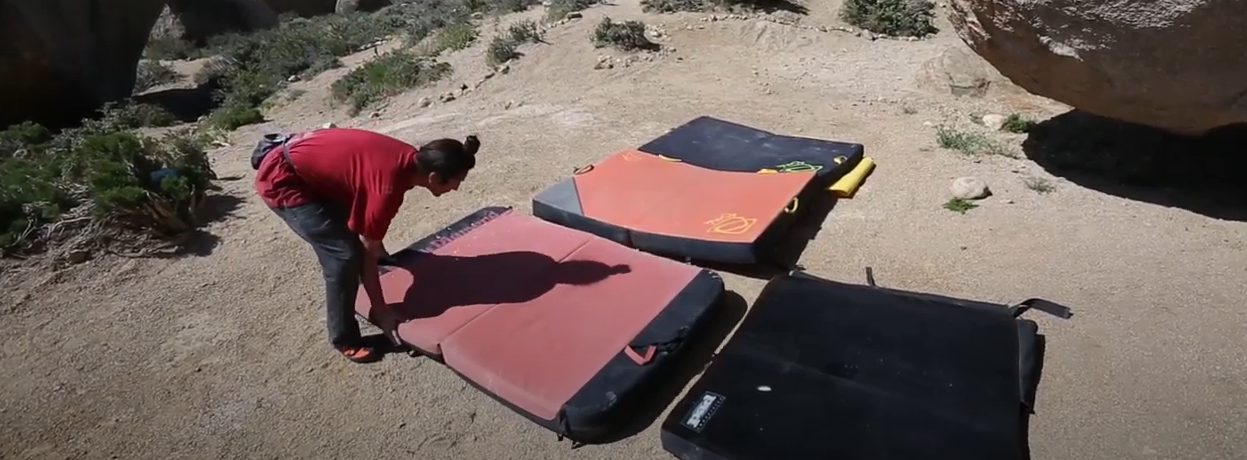
Before purchasing a crash pad there are a few important factors to keep in mind. Let us go through them in detail to give you a better understanding of what to look for.
Weight
Most safety mats measure between 10 to 20 pounds (4.5 to 9 kilograms). That said, the weight depends on size, foam thickness, and features.
Remember, how much a pad weighs is a crucial factor when deciding what type of climbing mat to purchase. For example, if you intend to climb high, you might need an oversized one, but be aware that you have to carry a heavy load on your back.
If you don't want to be handling too much weight, choose a light pad instead. However, by compromising for a thinner construction, you do sacrifice a bit of safety.
Foam Types
As a start, foam splits into categories: open-cells and closed-cells.
Cells of closed-cell foam prevent the entry of the air. That makes them stiff, as they cannot compress from the force of a fall during an impact.
Contrarily, open-cell foam is soft, smooth, and springy because the cells allow the entry and exit of air. Since open-cell foams do not have pressure, they fill with air. And when you land on them with force, the air in the cells releases, turning them into a comfortable cushion.
Foam Layering
Foam layering is vital in regards to padding. As you find yourself falling onto a pad, you don't want to bottom out but hope to fall on a cushioned surface.
Rock climbing crash pads combine open-cell foam and closed-cell foam layers. The top is usually closed-cell (firm) foam taking the force of the impact and spreading it out to the central layer of the open-cell (soft) foam, letting out air for cushioning. So, the closed-cell layer spreads the shock caused by a fall while the open-cell layer receives it, absorbing it.
Some climbing mats have additional layers of closed-cell foams on the bottom to prevent contact with the ground. Also, they shield the open-cell layer from moisture, mud, or snow. In other words, they do offer the best waterproof properties.
Thickness & Stiffness
Keep in mind that the standard mats on our list have 3.5 to 5-inch thicknesses. The thickness of the pad guarantees the quality of protection it provides from falls. Therefore, if you tend to fall from high places, you have to purchase a very thick pad. As a side note, by placing one pad above the other, you ensure additional protection.
Folding Type
Pads fold in the middle, becoming compact for easy carrying. While this transportation method is necessary, it also weakens the foam, which is not good. To solve this, manufacturers have tested many designs. And not one is perfect, as everyone has its advantages and disadvantages.
The different fold types are hinge, angled, hybrid, and taco-style.
Hinge
The most usual fold type on a bouldering crash pad is the hinge. A crash pad with a hinge has two different sections of foam linked with a cover made of nylon. These form a crease in the fabric just at the point where the pad folds. The great thing about the hinge is that foam cannot be compressed when it folds. That ensures pad durability while allowing boulderers to fold it shut without weakening the foam near the crease. Further, hinge mats can fold shut, making them super compact and easy to carry along.
Not everything is perfect, though. Unfortunately, a gutter may appear between those two foam pieces. That is most obvious on uneven, rough terrain. If you fall on such a pad, you will end up with rolled ankles. To avoid this, if you like bouldering near rugged landing surfaces, do not choose a hinged crash pad. But if you prefer climbing near a flat surface, this design is recommended, as hitting rocks and sharp ground is rare.
Angled Hinge
Angle hinge is rare to find on a crash pad. It is similar to a regular hinge because it has two foam pieces. However, both have angles on one of their sides. So, when it closes, the top foam piece extends to the downside. At the same time, the bottom reaches the top. In this way, angle hinge climbing mats are compact and can stay folded for a long time without risking foam durability.
Hybrid Hinge
Hybrid hinge design combines hinged pads and adds a thin and continuous foam layer over the top. For instance, a 4-inch pad folds independently, but 1-inch foam covering the gap. Hybrid hinge designs offer a nice balance, as they may not be very compact, unlike regular hinge pads, though they do close in a convenient way, unlike taco-style ones.
And they may not reduce the gap as much as taco-style designs, but they fair better than hinge pads. Manufacturers that use hybrid hinge pads use memory foam as the top layer. Memory foam, also used in pillows or shoes, compresses without losing its form and shape. Therefore, it makes a superb material for hybrid-hinged mats.
Taco-Style
As to the taco-style designs, they have open-cell-and-closed-cell foams. The foams fold in the middle, offering comfortable transport. Trying to fold foams of 5 inches is not the easiest thing possible, so folding these requires tremendous effort to secure their buckles.
But the best advantage with taco-style mats has to do with the fact that the gutter is non-existent, offering a continuous safe landing zone to protect from accidental falls. Consequently, if you prefer rugged terrain for bouldering, a taco-style might be the best choice for you for mitigating gaps and moving over sharp debris.
Finally, taco designs are spacious and can hold a daypack, but not more than that. Perfect for bringing all of your gear along.
Regrettably, taco pads cannot stand even when opened. But they have to flip on another side until their foam expands.
Additionally, being made from a softer foam compared to hinge mats, they may not absorb the force caused by a high fall very well. And the foam area compresses in the foam. Eventually, it will lose its shape, minimizing its lifespan.
Also, being heavy to carry, taco pads might feel more uncomfortable than other pad styles.
Closure Systems
Buckle
Every pad has a different closure system that enables it to remain closed during transport. Most have a bunch of buckles on the side, the down part, and the top. Some of them are more convenient to handle than others. What is more, others might be very durable.
But if you need secure compartments to store any items, such as a mobile phone, navigator, or satellite communication device, buckle closures might not be the best option. And that's the downside, despite being easy and convenient for transport.
Flap
The flap closure is another system found on most mats. These flaps cover the top and the downside of the shut pad while buckles secure everything neatly. Flaps are great as they prevent items from falling since they remain firm inside the shut crash pad.
Plus, the flap closure is fantastic because boulders can use it to carry another pad or fold it out for cleaning their feet. It even wraps about the pad protecting the suspensions. In this way, you can drag it to place it under a boulder to help the straps not get torn by rocks.
Zipper
The zipper is the last closure system, and it is considered a unique design. With a zipper, there is no worry that small gear or loose items will fall. It creates ideal carrying compartments. On top of that, the flap opens, flipping around the climbing mat, protecting the suspensions. In this way, a flat surface is created that does not stick on rocks or getting ripped apart when dragged.
However, the zipper closure has one downside: durability. Zippers fail over time and after constant use needs replacing. If not, they render the pad challenging to bring along.
And it might be hard to close, too.
The good thing is that the zipper packs taco-style designs better and more secure than the other available closure systems.
Organization
The organization of a crash pad consists of storage space. When you need to carry shoes, water, food portions, and a large mat, organization becomes a significant factor. The majority of pads allow the carrying of objects within the fold.
One thing to note is that taco-style designs are the most spacious, while triple-fold ones are the hardest to pack. Also, worm-in pads might carry gear better compared to brand-new and firm ones.
If you are looking for pads with the best security, choose those with zippers and flaps. By doing so, you ensure the safe transport of your stuff.
Durability
Overall, bouldering crash pads are tough. From their nature, they have been designed to withstand rough conditions, such as being pulled, sit on, and take falls. They have a cover surrounding the foam, protecting it. This cover is made of thick, tough nylon.
Also, some might feature sturdy fabric for additional protection, such as a waterproof coating or reinforced corners.
The 6 Best Boulder Crash Pads
It's time to take a close look at the top choices on the market. We've put them to the test and these are the results.
1. Metolius Magnum Crash Pad


Dimensions: 70 x 47 x 4 in.
Thickness: 5 in.
That is a super large tri-fold climbing crash pad that is full of features. Even though the Metolius Magnum is large, it is not hard to carry it around during long excursions. The tri-fold design makes it look narrow when on the back, so when you need to go through trees or bushes, it is much easier to handle than classic large pads, which fold in the middle.
With the Magnum, you can have as much space as you will ever need, as it offers immense coverage. Just by having it around, you get a confidence boost and can climb higher than ever before. And it makes a superb base when stacking pads. Honestly, the Magnum could be the best climbing crash pad, as it is easy to carry and ensures maximum protection.
As expected, the Magnum is incomparably durable. It has a tough nylon fabric cover that can be moved over any terrain, no matter how rugged it is. On top of that, the pad has flaps protecting the velcro side when it folds. The hip belt and the shoulder straps are durable, too, as they are reinforced and sewed on several points to protect the fabric from stretching.
And, as expected, the Magnum is designed for total impact absorption with its innovative Sandwich foam. The top is closed-cell foam and connects to an open-cell foam center and a closed-cell bottom. So, the force of an impact is transferred from the firm top to the soft middle, fading off as it reaches the stiff downside. In this way, the body does not feel shocked as it lands on the pad and maintains its balance, avoiding injuries.
The tri-fold has only one downside, and that is that you cannot pack all of your items inside it, passing the pad off to a fellow boulder as a handy bag. Some might do not like this, but for others, it may not be a dealbreaker. With some adjustments, though, everyone can learn to accept the nature of the pad.
That said, the Magnum is one of the best bouldering crash pads on the market and a climbing staple for years. It manages to offer an alternative high-quality crash pad solution to the classic bi-folding design, and that is simply fantastic.
2. Metolius Session II Crash Pad

Dimensions: 50 x 37 x 4 in.
Thickness: 4 in.
The Metolius Session has been a superb pad for many years. Now, a second, updated version is available on the market.
The Session II is relatively affordable and packs great features. For starters, it boasts some of the softest rock climbing crash mats we have ever tested. It is perfect for low falls, but we did not feel much confidence testing it once we were high off the ground.
Further, the Metolius Session II has an angled hinge design that can bottom out if an obstacle, such as a rock, points into the hinge from the ground. However, with the angled hinge, that is unlikely.
As mentioned before, the Metolius Session II is an affordable pad, which is excellent. Regarding its foam, it exists in such a way that cushions in most scenarios, especially in short back-jarring falls to medium-high falls. Furthermore, the pad can store an average-sized daypack with the convenience to open and close the 1 buckle flap.
As a backpack it fairs well, too. The shoulder straps along with the modifiable waist belt, making comfy to carry medium loads. Durability-wise, the Session II is bound to last many seasons and climbing trips of consistent use.
Therefore, everything is fine with this pad. It may not be the best one, but it gets the job done, and sometimes that is more than enough.
3. Black Diamond Circuit Crash Pad


Dimensions: 47 x 35 x 3.5 in.
Thickness: 3.5 in.
As a start, the Circuit Crash Pad is small, just 3.5-inches in thickness. Unfortunately, that makes it not very durable, unlike other pads on our list. And it is not that spacious, too.
However, the Black Diamond Circuit Crash Pad is value-for-money, as it has an incredibly approachable retail price. Consequently, for inexperienced bouldering enthusiasts, it might be the best crash pad option.
At this point, we think that a little more information about the cell foam is necessary. The top of the pad has closed-cell foam, supported by a high-compression polyurethane foam on the bottom. On top of that, the top is made of 900-denier nylon. This durable nylon is also on the sides and downside, ensuring resistance to water and abrasion. That makes the pad a good choice for rugged terrain, snow, or mud.
That said, if you are a boulderer with substantial experience in climbing, we cannot recommend the Circuit, as the 3.5-inch foam is not enough to defend against bottoming out. Competitive pads have more foam and a wider footprint. For a supplemental crash pad, though, the Circuit makes a great option.
And the fact that it comes from a manufacturer with a solid history in climbing products can only be a good thing, too. Black Diamond is renowned for the high quality of materials they use in their pads, with the Circuit being no exception.
4. Mad Rock R3

Dimensions: 56 x 35 x 4 in.
Thickness: 4 in.
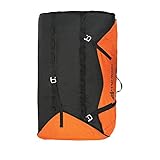
Mad Rock R3 is in a category on its own, as it stands between standalone and supplementary crash pads. The Rock R3 has seven separate baffles filled with shredded closed-cell foam, just like a down jacket. In comparison, most competitive mats to R3 are layered with open-and-closed-cell foams, such as the Mad Pad (also on the list). In this way, the R3 can provide comfort on uneven, even sharp surfaces and a cushioned landing zone.
And it is incredibly flexible, too. So climbers can carry it with ease.
The R3, however, is not perfect. For once, the lack of a continuous layer of closed-cell foam might make you hit the ground after a fall. Likewise, uneven baffles make for a lumpy landing surface, even on flat terrain. Plus, R3's seams between the baffling contain a small layer of foam, so instead of one large gutter, there are six small gutters.
And it is slightly heavy, too.
That said, the heavy-duty polyester cover and the option for foam replacement make the R3 a crash pad that will last for quite a while and one of the best bouldering crash pads available.
5. Black Diamond Drop Zone


Dimensions: 56 x 35 x 3.5 in.
Thickness: 4 in.
The Black Diamond Drop Zone has a taco-style closure. In fact, the Drop Zone is the only taco-style pad in the renowned Black Diamond lineup. It is light for the surface area that it covers and generally performs very well. For high falls, however, it might not be the best possible choice. For these situations, you are better off with the Mad Rock R3.
But if you are a climber who loves doing a circuit of short boulder problems, then the Black Diamond is for you.
To be a bit more specific, the Black Diamond Drop Zone is thick and has a taco closure. The issue is that since Drop Zone's padding is just 3.5 inches, rocks in the landing zone can be felt, unlike Mad Rock, for example. The padding, in other words, seems less safe than competitors.
And the taco closure of Black Diamond is an issue, too. It is not easily adjustable, as it holds its folded shape. As we set it up, at the base of landings, the closure was U-shaped. So, when we placed it on rocks, the U-shape made the pad roll off to the ground. We expected a lot more from Black Diamond and the Drop Zone.
6. Mad Rock Triple Mad Pad

Dimensions: 44 x 72 x 5 in.
Thickness: 4 in.
The Mad Rock Triple Mad Pad is one of the least expensive pads and has many features. As a start, it has a tri-fold design that transforms it into a comfortable bed. In addition, the Mad Rock—not to be confused with the Mad Rock R3 or Rock 3 that is also on the list—has Velcro tabs that hinge together, constituting it durable.
Despite its approachable retail price, Mad Pad offers a generous amount of foam. With a 5 inch thick foam, the Mad Rock Triple Mad Pad is very stiff, nearly identical to the foam found in the Rock R3.
While we tested it, we put it over a sharp rock, and it was impossible to bottom out, no matter from how high we fall. However, the stiff foam needs time to break in. Until that happens, it is too hard to fall on, causing slight back pain.
Further, the durability of the Mad Rock Triple Mad Pad is impressive, with a 5-inch thickness that is composed of 3 inches of soft open-cell foam between two stiff 1-inch layers of closed-cell foam. So, the Mad Rock Triple Mad Pad will last at least a few seasons of consistent use until it gives away, just like its cousin, the Mad Rock R3.
Also, add the ability to combine the Mad Pad with other Mad Rock pads with Velcro strips, such as the Mad Rock R3, and you might have the ultimate climbing tool.
The Mad Rock Triple Mad Pad is affordable, has a fantastic amount of foam, and a decent size. What more could a climber need?
Frequently Asked Questions:
1. How many crash pads do I need for bouldering?
That depends on the boulderer. Some feel safe with just one pad, but others need to invest in three separate safety mats if they intend to climb some seriously high cliffs. One piece of advice for inexperienced climbers is that they should not try to recreate the gym floor. That might be dangerous in the outdoors. Everything, however, boils down to the climbing area. Instead of investing in many mats, it is better to bring a couple of friends along. More mats and more fun, without extra cost.
2. How do you use a bouldering crash pad?
Using a climbing mat is not challenging. You place it under the rocks that you're climbing. That said, it does require a clever set-up to maximize protection if no flat ground is available but sharp debris or roots.
First, take extra care and find fall zones. That is the space where climbers will most possibly fall. It may appear obvious where a fall zone is, but we assure you that it isn't. Sometimes the fall zone is beyond the boulder base, especially if the terrain is steep.
Moreover, uneven ground is dangerous, so try and even the landing out by placing pads in holes. If the holes are super small, fold the mats in the middle to fit inside. After, place on top of them a large safety mat. Test your landing zone out by walking on the pad, trying to see if it doesn't collapse somewhere.
Furthermore, safety mats in such a way as to avoid rifts between them. The idea is that safety mats might move around due to climbers walking next to them, falling, or even sitting on them. Check out then that everything is as supposed to be, and, if not, push the pads to join each other, eliminating cracks.
Lastly, the higher a fall is, the greater the impact will be. It is wise to stack mats on top of each other, therefore. However, by stacking crash pads, you lose stability. Also, the gaps between them may get deeper. Consequently, be sure that you built your landing area well to avoid injuries and uncomfortable situations.
3. Why are crash pads so expensive?
They are expensive because they protect climbers. To put it simply, if you fall from a cliff without landing on a safety mat that absorbs the shock of your impact, the least of your injuries will be to break your legs or back.
And cheaper mats offer less protection than weightier ones, as expected. Do not, therefore, cut corners with hiking shoes and pads. Just buy the best that you can afford. Do not put a price on your safety.
4. What is a crash pad made of?
Crash pads are made by layering closed-cell and open-cell foam to absorb the force caused by a fall. Closed-cell foam offers more support, while open-cell provides boulderers with extra cushioning. Most mats use both foam designs in an effort to ensure safety from body injuries. On top of that, crash pads utilize sandwich structures. Open-cell foam layers are in the middle, surrounded by closed-cell foam layers on the bottom and top.
Now, crash pad foam is made of polyethylene, which is a popular material. The reason companies choose it is because it is firm and endures impacts. It is used in closed-cells without modification, but in open-cells, textile manufacturers put it to undergo reticulation. That is a process in which heat breaks down stiffening elements in polyethylene, creating sponge-like consistency.
As to the crash pad materials, many manufacturers use Cordura, a nylon fabric. It can blend with natural fibers, such as cotton. Others, though, prefer velvet, upholstery, or polyester. The most durable materials are polyester and nylon because they are synthetic. Polyester is abrasion and weather-resistant, but nylon is more durable. About the materials used in the exterior, that depends on the pad. For the most part, Nylon fabric is the top choice. However, there are pads with features like velvet top, rubber corners, or a carper material to clean your feet.
Conclusion
Without crash pads for rock climbing, bouldering is not possible. They are an integral part of the activity, as they ensure the safety of falling climbers and inspire confidence, pushing them to their limits.
Since they do not come cheap, it would be wise to do your research first to decide the best choice for your needs, rock-climbing style and aspirations, and landing surfaces that you usually encounter.
For instance, if you find yourself rock-climbing next to uneven surfaces, you can opt for the Metolius Session II.
But if your bouldering endeavors consist of flat landing zones, go for the Black Diamond Drop Zone.
And in the case you need endless foam that is both firm and comfy, go for the Mad Rock Triple Mad Pad without a second thought.
But for those looking for the best value-for-money choice, the Black Diamond Circuit should be their go-to option.
That said, all of our crash pad choices are durable, compact, have sturdy shoulder straps, and provide unparalleled protection. By recommending the best crash pads for bouldering in this guide with reviews, we hope we helped you choose the best one for your needs.